In 1842, England’s Royal Commission of Inquiry into Children’s Employment released its first report on child labor. The document, comprising data and interview transcripts that were gathered from investigators who visited labor facilities across England, shed a light on the horrendous treatment of child laborers and the systemic problems that perpetuated abuse among children as young as five. It was no secret in England that the country’s children were suffering on the job as authors like William Blake had already written poetry critical of the mistreatment of child laborers. But 1842’s official printed record filled with children’s own descriptions of the despicable abuses they received brought a new level of awe and awareness to the situation.
One page of the inquiry reported that a coal-field in Derbyshire had 1,241 child laborers, 725 of which were under the age of 13. One district reported that it was not uncommon for children under the age of five to be working in the pits.
While the figures themselves were a hard pill to swallow, the details of the treatment of the children only further shocked Britain. Instead of recounting with my own paraphrasing, I’ll let you read the accounts of Jane Richards (age 13), Phillip Phillips (age 9), Mary Reed (age 12), Joseph Latum (age 9), and James Robinson (age 14) below just as they were read by the people of England 178 years ago.


Charles Dickens was thirty years old when the inquiry was released. Dickens was so sickened by what he read in the document that he decided to write and publish a pamphlet whose purpose would be to mobilize England against the plight of child labor. Eventually he opted to write a story instead of a pamphlet, a story that has been told and retold, adapted and readapted perhaps more than any other work of literature. Dickens’ A Christmas Carol has been the source material for over 350 different films, television episodes, radio plays, stage plays, and books. Its simple message is transcendent and one that has yet to be outgrown by any generation.
I have read A Christmas Carol at least once every Christmas season for the last nine years. I have Paul Westover to thank for that. Spread out over dozens of seats in a small auditorium in the basement of the Joseph F. Smith Building on the campus of Brigham Young University, Dr. Westover recited powerful lines from the story and filled us each with a passion for the text as we studied it together in our Transatlantic Literature course. I cannot help but hear Dr. Westover’s voice, reciting with sincerity and power, each time I read Jacob Marley’s description of the chain worn by Scrooge: “Or would you know,” pursued the Ghost, “the weight and length of the strong coil you bear yourself? It was full as heavy and as long as this, seven Christmas-eves ago. You have laboured on it since. It is a ponderous chain!” (Dickens 13).
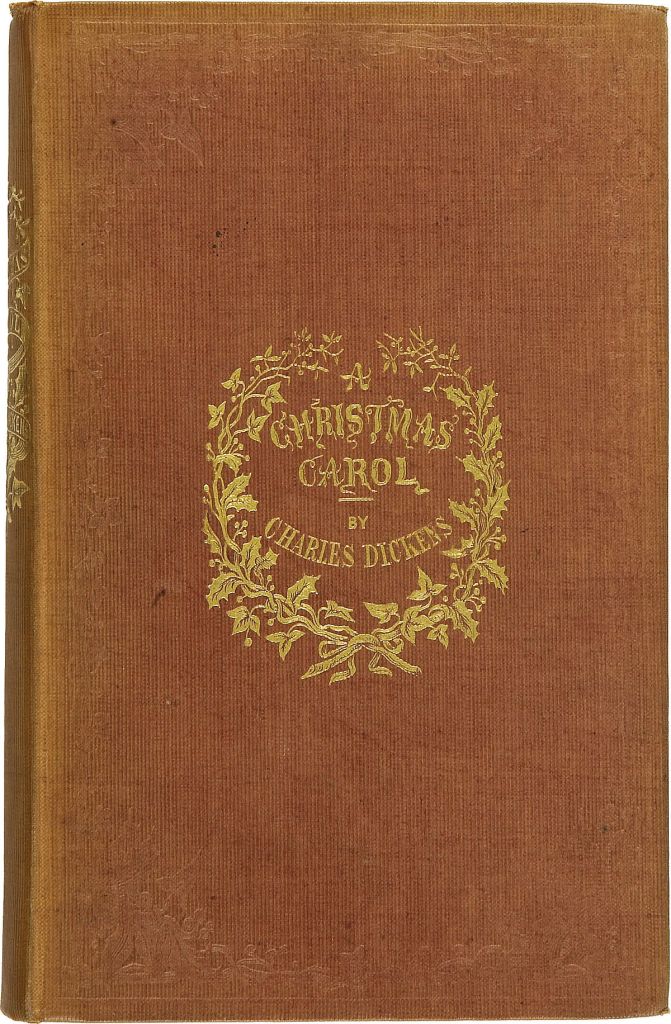
Every year is a great year to read A Christmas Carol, but 2020 is a particularly great year to read this classic. Dickens wrote his yuletide masterpiece for an England that was torn on how to help the poor. Some, like Scrooge in Stave I, believed that those in poverty were “idle people” who needed to take better advantage of government programs if they were to survive or rise out of their situation (Dickens 6). Over a century later and this attitude still persists among some. Likewise, we live in a time of drawn lines, absolutist approaches to politics and social issues, and a ceaseless spigot of information and counter information for every conceivable fact and fiction. Like the Blue Eyed Son, we see “a room full of talkers whose tongues [are] all broken” (Dylan). We behave like a nation of critics with one goal: make the other side look bad, stupid, and incompetent. And as humans are inherently flawed, this is easy work. It flourishes with ease thanks to the social media echo chamber. With each person we block and each news source we refuse to read, we, like Mildred Montag, complete our personal four-walled parlor that tells us everything we want to hear and in the way we would like to hear it–no thinking necessary (Bradbury 248). The final result is a vision of the world in which everyone is wretched, conniving, and foolish.
So what does all of this have to do with Scrooge? Poor Ebenezer’s greatest struggle is not that he is inherently a “squeezing, wrenching, grasping, scraping, clutching, covetous old sinner” (Dickens 2). Scrooge’s downfall at the start of the story is that he lacks perspective. He is oblivious to the long-suffering of his nephew in reaching out to him, he is oblivious to challenges faced by Bob Cratchit (in particular Bob’s sweet and infirm Tiny Tim), and he is oblivious to the struggles of the poor all across England. Scrooge’s limited perspective is a direct result of what he values most at the story’s start: his business.
When asked to consider the suffering of the poor, Scrooge responds, “It’s not my business. It’s enough for a man to understand his own business, and not to interfere with other people’s. Mine occupies me constantly” (Dickens 6). Later, when the ghost of his deceased business partner appears to him, lamenting his life wasted on industry, Scrooge interjects, “But you were always a good man of business, Jacob” (Dickens 14).
“Mankind was my business; charity, mercy, forbearance, and benevolence, were, all, my business…”
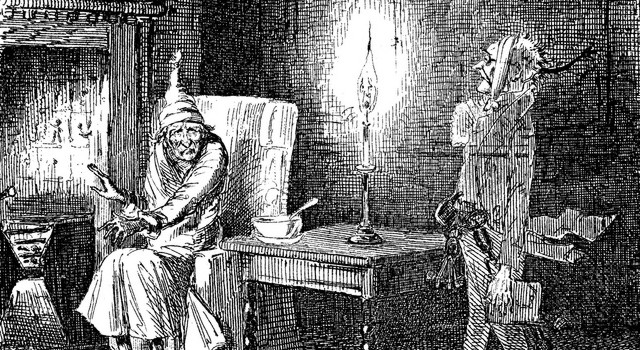
“Business!” Marley replies in weeping syllables. “Mankind was my business; charity, mercy, forbearance, and benevolence, were, all, my business. The deals of my trade were but a drop of water in the comprehensive ocean of my business!”
This retort from Marley is a direct jab at the capitalist mentality. Capitalism in America exists as an economic frame that encourages competition and aims to benefit businesses most as capitalism sees businesses as the lifeblood of a nation, either providing more jobs and money or less jobs and more poverty. While I do not think capitalism is a bad thing, I do believe it has become something that it was never meant to be, a sort of god who is meant to solve every problem in our country.
I watched a video a few months back posted to YouTube by Robert T. Kiyosaki, the author of Rich Dad, Poor Dad, in which Kiyosaki claims that everyone who is surprised that Trump pays basically no taxes is stupid because the rich have never paid taxes. Kiyosaki goes on to explain that the rich should not pay taxes since their existence stimulates the economy (and therefore the nation) so much due their investments in businesses and government projects. I’ve thought about this video much since then, and I have decided that I disagree with Mr. Kiyosaki from a societal standpoint. He is right that in a dollar and cents metric, his money has done more for the economy than my tax dollars have, but he disregards the many unquantifiable contributions made by Americans. Take for instance the public education system. American teachers receive low wages and have zero upward mobility in the position of teaching, yet their work is one of the most essential operations in the country: the education of its citizens. But there is no way for teachers to get a tax credit for providing an education to the country subsidized at the cost of their own wages. Should we not put the same premium on literacy that we do on employment statistics or the GDP? How much about our country could improve if the metrics we used for national welfare emphasized literacy, education, and quality of life as opposed to the stock market which most Americans do not own a significant share of?
While Mr. Kiyosaki’s trade is that of literal business, each of us (like Scrooge) has some business that occupies us. It may be a trade, a job, a hobby, a political movement, family, personal challenges, social media, or one of countless others. We need not abandon this “business” (though for some it may be beneficial). Dickens’ novel does not end with Scrooge selling the counting house and abandoning lending altogether. Rather, the story ends with a penitent Scrooge seeing his business as but “the drop” and making the real emphasis of his existence to listen to, understand, love, and serve others .
Near the story’s end, a Scrooge plagued by the possible future brought about by his misdeeds cries, “I will honour Christmas in my heart, and try to keep it all the year. I will live in the Past, the Present, and the Future. The Spirits of all Three shall strive within me. I will not shut out the lessons that they teach” (Dickens 62).
May we all live not only in our own past, present, and future, but those of the people who surround us and may we see the entire year as a time to “open [our] shut-up hearts freely, and to think of [others]… as if they really were fellow-passengers to the grave, and not another race of creatures bound on other journeys” (Dickens 4).
Sources
- Bradbury, Ray. Fahrenheit 451. Harper Voyager, 2013.
- Dickens, Charles. A Christmas Carol. Dover Publications, Inc., 1991.
- Dylan, Bob. “A Hard Rain’s A-Gonna Fall.” The Freewheelin’ Bob Dylan, performed by Bob Dylan, Sony Music Entertainment, 1963.

Stephen M. Nothum
was born in St. Louis, Missouri. From a young age he was crafting stories, mainly sprawling epics with action figures. He is a graduate from Brigham Young University with a BA in English Teaching and currently a high school teacher in Eugene, Oregon. When he can get himself to, Stephen likes writing fiction that explores reality, perceptions, and pop culture. Stephen’s favorite writers are C.S. Lewis, Kurt Vonnegut, Flannery O’Connor, Ray Bradbury, and Will Sheff.
Stephen has published poetry, fiction, and academic articles in various literary and academic journals. He has also presented at state and national conferences on writing and teaching writing, and he has worked as a professional consultant to teachers helping them improve their craft.

 Stephen Nothum
Leave a comment